
Using Email Marketing to Test Minimum Viable Products (MVPs)
A guide on using email campaigns to test and validate new product ideas rapidly with minimal investment, directly contributing to product development and scaling.

Lately, I’ve been helping clients with offer creation & list-building.
And it’s led to me developing a unique system that practically guarantees any offer you create + launch makes you money.
First, let me give you the backstory:
You see, tons of people will spend months… YEARs, even building a product…
But then it doesn’t sell.
(Lots of SaaS & Ecom companies do this btw.)
Apart from building the product though…
Lots of people will try and promote a particular offer, and that doesn’t convert either.
So today, I’m gonna show you how you can practically guarantee any offer you create & bring to the marketplace sells.
Whether you’re thinking of creating a new offer or even just refining the messaging on an existing offer to make it convert better, this newsletter will help you.
And it’ll also save you thousands of hours & dollars.
There’s 3 parts to this system:
Validating the idea itself
Seeing if your audience likes the idea
Test launch
Let’s start with part 1, validating the idea.
1. Validating the idea
A quick story here:
A while back I did a list building training…
And one of the biggest things I learned was how to select the right “bait” to grow your email list.
But after doing this to build lists for me and clients, I had an epiphany…
I realized the same strategy actually works with PAID products too (not just lead magnets).
So I started weaving this strategy into my offer creation process.
And I realized, this same strategy worked not just for selecting “lead magnets”…
It also worked for validing product ideas, too.
Now there’s all types of ideas from running surveys, to testing CTR and Facebook ads and such…
But the ONE method that’s never let me down, when it comes to having profitable launches to an email list is this:
Turn your best email subject lines into a product.
In fact, companies have built their way to $100M per year in sales following this method, such as BioTrust.
Here’s a couple examples:
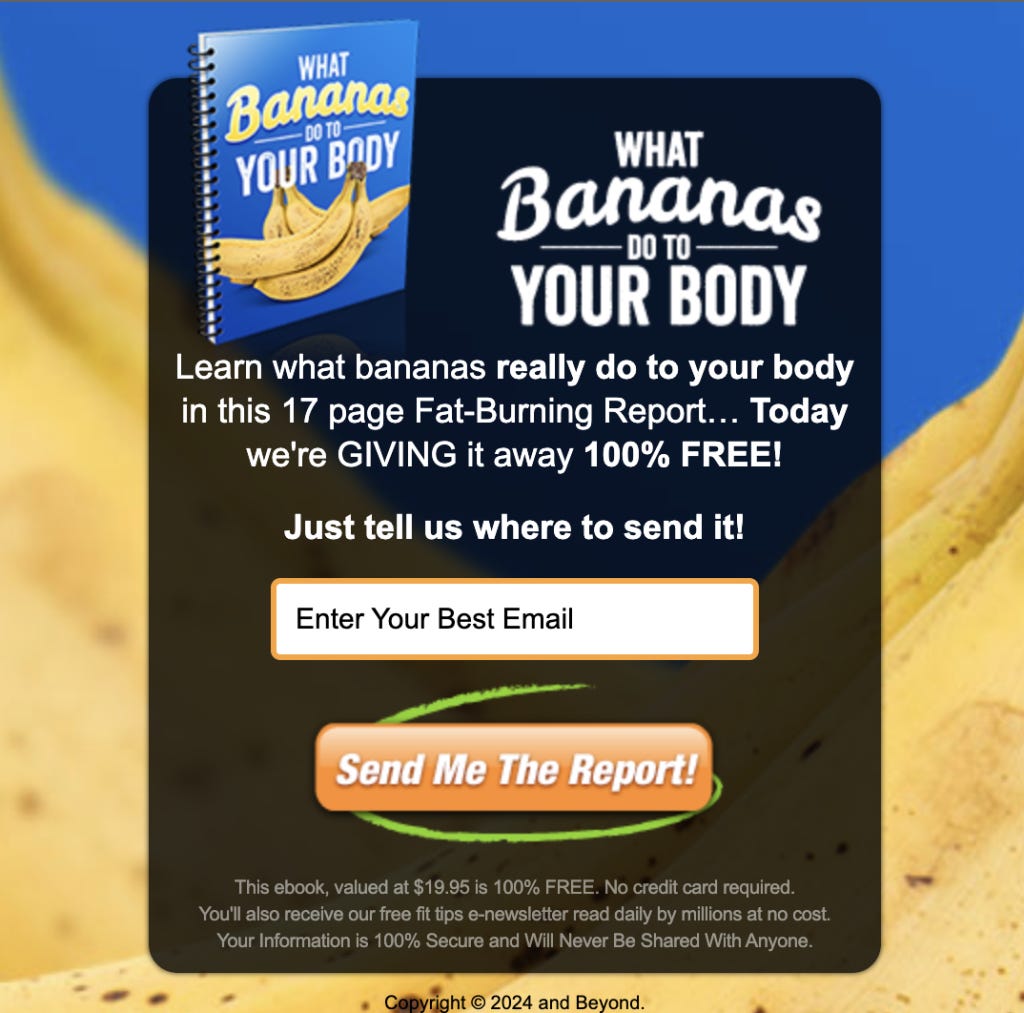
1. What yellow bananas do to your body
2. 9 foods that fight DEADLY visceral fat (eat these daily)
3. Always eat AFTER 7 PM (here’s why)

This last one actually became a high-grossing offer on Clickbank.
So this subject line was a product in and of itself.
(These were previously top-performing subject lines that were turned into opt-ins for free reports.)
The principle here, though, is the idea/angle used. Not the product itself.
In fact, one book grew it’s sales by 733% just by changing it’s title…
Originally, the book was titled “Fleece of Gold,” which did not perform well in terms of sales. When the title was changed to “The Quest for a Blond Mistress,” sales increased dramatically from 6,000 copies to 50,000 copies, illustrating the power of a compelling and relevant title in boosting sales.
Same content, different title.
So, if you take nothing away from this, remember that it’s the angle you use in your messaging that gets people to buy.
Even a great product won’t just sell itself.
Unless you wanna spend decades getting people to use it for free, and then get reviews. But we know people don’t value free, anyway…
So even if you give a good product to people for free, you won’t elicit the same response from your target audience.
So it’s always good to test buying angles first.
Next, let’s talk about how to see if your audience will buy your new offer.
2. Would my audience want this?
We now know your audience is interested in your idea.
In other words, the angle/messaging is something your audience likes.
The next part is to see if they’d actually, BUY this thing.
So, you have to actually ask them at this point.
Basically, a “Hey, I’m thinking of doing this special offer, would you be interested?” type thing.
Now, there’s 4 steps to this process:
The Initial Email
Gathering Feedback and Analyzing Interest
Using Psychological Triggers in the Follow-Up Email
Finalizing the Follow-Up Email Strategy
If you don’t follow these steps, it can impact your results. So It’s important you read through all these steps and don’t skip them.
Here’s the 4 steps…
1. Crafting Your Initial Email
Start with an email that introduces your concept and gauges interest. The goal is to get a clear indication of whether your audience would be willing to pay for your idea.
Subject Line: Use curiosity and clarity. Example: “I Have an Idea – Would You Be Interested?”
Email Body:
Introduction: Briefly explain the concept you’re thinking about.
Benefits: Highlight the main benefits your audience would gain.
Call to Action: Ask them to reply with a commitment statement, like “I’d buy it,” to gauge true interest.
Here’s an example you can copy:
Subject Line: I Have an Idea – Would You Be Interested?
Body:
Hey [First Name],
I’ve been exploring some exciting new techniques in [Your Field] and the results have been incredible – think [Insert Specific Benefits, e.g., “effortless productivity boosts,” “significant ROI increases,” etc.].
I’m considering putting together a [workshop/course/product] to share these techniques. It won’t be free, but you can pay what you want – whether it’s $1 or $100, it’s up to you.
Would you be interested in this kind of training? If so, just reply to this email with “I’d buy it” to let me know.
If there’s enough interest, I’ll set it up. If not, no worries – I’ll keep these techniques to myself.
Looking forward to your thoughts!
[Signature]
2. Gathering Feedback and Analyzing Interest
After sending the initial email, it’s crucial to gather feedback and analyze the responses to determine if there’s enough interest to proceed.
Look at the number of responses and the enthusiasm in the replies to determine if there’s enough interest to proceed with the development.
You could even mention something like, “If I get at least 100 responses from this email, I’ll do it. If not, I’ll just move on and keep these tactics to myself.”
This last part just gives you some bonus leverage.
3. Using Psychological Triggers
This part is crucial for the actual conversions of the launch.
You’ll want to utilize psychological principles to increase engagement and commitment in your followup email.
For example:
Commitment and Consistency: Asking your audience to say “I’d buy it” helps them commit to the idea, increasing the likelihood they will follow through. This leverages the principle that people want to be consistent with their commitments.
Social Proof: Highlight how many people have already shown interest in your follow-up emails to build momentum and credibility.
4. Finalizing the Follow-Up Email Strategy
Send a follow-up email based on the responses received:
Subject Line: Use excitement and validation. Example: “Wow, The Response Has Been Overwhelming!”
Email Body:
Reinforce Interest: Share the number of positive responses to build social proof.
Confirm the Launch: Announce that you will proceed with the idea based on their feedback.
Details: Provide more specifics about what the product will include and how it will benefit them.
Example Follow-Up Email:
Subject Line: Wow, The Response Has Been Overwhelming!
Body:
Hey [First Name],
I’m thrilled to share that over [X number] of you have replied saying “I’d buy it” to my idea for a [workshop/course/product].
Clearly, there’s a lot of interest in this, and I’m excited to move forward!
Here’s what’s next:
– [Briefly explain what the product will cover]
– [Highlight key benefits again]
I’ll be hosting this live on [Date] via Zoom, and it will be recorded for those who can’t attend live.
Thank you for your enthusiasm and support! Stay tuned for more details coming soon.
[Signature]
Awesome!
So to recap…
You’ve now:
Found a proven idea (based on your previous subject lines)
Got your audience to confirm they would buy this idea.
Told your audience you are going to launch this idea
The last part, part 3, is the actual offer itself.
This kinda deals with fulfillment and whatnot.
Part 3: Test Launch
Setting Up Your Test Launch
Once you’ve validated the interest, it’s time to prepare for the test launch.
This phase involves a limited release to further confirm demand and refine your offering.
Here’s some options you can do:
1. Limited-Time Offer:
Create urgency by offering the product for a limited time or to a limited number of people.
This is the hallmark of any successful launch.
Urgency/Scarcity are crucial sales elements.
2. Refundable Pre-Order:
Say you’ll only create the product/deliver it if a certain number of people buy it. If you don’t hit that number, everyone gets a full refund. This can work a lot in community offers too, because people are like, “c’mon guys buy this, we all really want it and we need your participation.”
3. Pay-What-You-Want Pricing:
Encourage participation by letting people choose their price, which helps gauge the perceived value.
You can do this in Stripe with variable pricing. Or even ConvertKit has it’s own “tip jar” product.
Many commerce platforms will let you set up this pay what you want pricing model. And it’s a good model to use.
Conclusion
Creating and launching a successful offer to your email list doesn’t have to be a guessing game…
Like you saw today, by leveraging proven methods of idea validation, gauging audience interest, and executing a strategic test launch, you ensure a higher return on your investment of time and money spent on product launches.
To recap, here are the steps we’ve covered:
Validating the Idea: Turn your best-performing email subject lines into compelling offers and testing these angles before full development.
Seeing if Your Audience Likes the Idea: Use a structured approach to gather feedback and commitment from your audience, ensuring they are willing to pay for your idea.
Test Launch: Execute a limited release with tactics like limited-time offers, refundable pre-orders, or pay-what-you-want pricing to confirm demand, and minimize risk of a new offer.
By following these steps, you can practically guarantee that any offer you create will resonate with your audience and drive sales.
Not only will this approach save you countless hours and dollars, but it will also build trust and loyalty with your subscribers as they see you consistently delivering valuable, in-demand products that they love to purchase from you.
So, the next time you’re contemplating a new offer, remember to validate, engage, and test. Your email list will thank you, and your bottom line will reflect the success.
Here’s to you making multiple 5 to 6-figures on your next launch. Just like THIS one did...